

 Biocontainment
 Biopharma
 Healthcare
 Brochures
 User Manuals


Let's deliver on your mission together.
Tell us about your project and we’ll connect you with the right team within 24 hours.

Sales: + 1 (386) 265-4300

Service & support: cs@germfree.com
CTA: text with button on coloured background
Looking for something custom?
We have deployed research facilities for shipment by military aircraft, designed equipment to contain the most dangerous agents on the planet, produced facilities to manufacture lifesaving medicines and mobilized hospital compounding during times of regulatory change. Connect with Germfree experts to unlock your scientific potential.
CTA: Linkedin

Follow us on linkedin to keep up to date about new open positions
List (FAQs)
Frequently Asked Questions (FAQ's)
- What is the Smarthood™ and how does it improve IV workflow efficiency?
The Smarthood™ is a fully integrated primary engineering control (PEC) that consolidates the entire IV compounding workflow into a single hood. Traditional IV preparation requires technicians to move between separate devices for scanning, documentation, weight verification, and labeling, each transition introducing potential for error and lost time. By bringing all of these steps together inside the sterile field, the Smarthood™ reduces physical movement, minimizes workflow interruptions, and supports cleaner documentation from start to finish.
- What features are included in the Smarthood™?
Both Smarthood™ configurations come fully equipped with integrated barcode scanning, photo capture, a field of view camera, a built-in PC, Jabra speakers for enhanced communication, sterile label printing, and easy integration with existing IV workflow software. Scanning confirms correct drug and diluent selection, photo capture and the field of view camera create a comprehensive visual record of each compound, and the built-in label printer produces sterile labels without any external equipment. Gravimetric verification is available for both models as an optional upgrade, providing real-time weight-based accuracy checks for facilities that want an additional layer of compounding precision.
- Is the Smarthood™ compatible with hazardous and non-hazardous drug compounding?
Yes. The Smarthood™ is available in two configurations, one for hazardous drug compounding (BSC Model) and one for non-hazardous compounding (Laminar Flow Hood Model. The Smarthood’s are built to meet the requirements of USP <797>, which governs sterile compounding practices, and USP <800>, which sets the standards for the safe handling of hazardous drugs in pharmacy settings. Whether your team is preparing standard sterile preparations or working with hazardous agents, the Smarthood™ provides a compliant, purpose-built environment that supports both safety and efficiency.
- How does the Smarthood™ reduce compounding errors?
Compounding errors most often occur at transition points, when technicians step out of the sterile field, move between devices, manually transcribe information, or work around gaps in the verification process. The Smarthood™ eliminates those vulnerabilities by keeping the entire workflow within a single controlled environment. Real-time gravimetric verification confirms accuracy at every step, and integrated image documentation creates an automatic audit trail, helping teams catch errors before any preparation reaches the patient.
- Does the Smarthood™ integrate with my current pharmacy systems and software?
Yes. The Smarthood™ is designed to complement existing pharmacy technologies rather than replace them, making adoption straightforward for most facilities. It can be implemented without major changes to your facility layout or digital infrastructure, working alongside the pharmacy information systems, compounding workflow software, and verification platforms already in use at your site. The Smarthood™’s built-in PC and integrated software capabilities are engineered with compatibility in mind, so your team can transition smoothly into a more efficient compounding environment without the cost or disruption of a large-scale technology overhaul.
Spec list (icons)
Modular Cleanrooms Specifications

Room Classification Types
- CNC Entry Room, Grade B (ISO 5)
- Grade C (ISO 7), Grade D (ISO 8)

Mechanical
- Stand alone, Freestanding modular facility no shell building required
- Fully integrated HVAC maintains critical environment conditions, provides segregation between bioprocessing and admin spaces
- HVAC is sized to provide optimal ACH rates in each room, entry, exit, personnel airlocks, and processing spaces. – Bio-decontamination compatible Personnel Airlock(s), low wall returns, and ductwork
- Temperature, Humidity, & Differential Pressure Controls

Electrical
- Internal site power connection
- Seamless backup UPS power for critical cleanroom and building management system equipment
- NFPA 70 NEC 2017 Compliant

Plumbing
- Ready to accept site infrastructure for both fresh and grey water

Door Controls
- Wave to open door controls with configurable interlocks and timing

Building Management System
- A central BMS controls HVAC through our calibrated sensors including temperature, humidity, differential pressure, valve positioning, and exhaust controls
- The BMS monitors and distributes all facility data using BACnet communication protocols

Environmental Monitoring System
- 21 CFR Part 11 compliant EMS system serves as permanent record keeping and storage with compliant visual and audible alarms, report generation, message lists, and access levels
- The EMS reports data from calibrated sensors on refrigerators, freezers, incubators, Grade D/C classified spaces and more

Architectural
- Durable against harsh cleaning agents such as sporicidal agents and VHP
- Every build decision prioritizes a sealed, smooth, cleanable and compliant interior envelope
Gas Piping
- Gas manifolds accept a variety of gases. (co2,o2,n2, & compressed air for example)
- Oxygen cleaned piping to minimize potential contaminants
- 316L Stainless Steel, ASME-BPE Compliant

Integrated Equipment
- Germfree Biosafety Cabinets (BSC’s)
- Integrated Active-HEPA Material Pass Through(s)

Security, Access, Fire & Data
- Sprinkler, Material, & Fire panels built to local code
- Emergency eye wash and power backup for other life safety systems
- Code Access with optional Key card access into facility

Site Requirements
- Concrete pad or pillars
- Fresh and Grey Water connections
- Electrical utility connections
- Staff access and site security
Toggles
Single Module for Large Process Equipment
Single Module for Large Process Equipment
The flow of this facility contains a CNC Entry Room, Grade D Anteroom, Grade C Processing Suite, Grade D Anteroom, and a CNC Exit Room.
Explore dimensions
Click on image below to expand

Single Module Large Grade B Suite with Unidirectional Flow
Single Module Large Grade B Unidirectional
The flow of this facility contains a CNC entry room, grade D Anteroom, grade C anteroom, large grade B processing suite, grade C anteroom, grade D anteroom and a CNC exit room.
Explore dimensions
Click on image below to expand

Single Module Large Grade B Suite with Bidirectional Flow
Single Module Large Grade B Suite with Bidirectional Flow
This facility flow includes a CNC entryroom, grade D anteroom, large grade C processing suite, grade B anteroom, and a grade B processing suite allowing for a bidirectional flow throughout.
Explore dimensions
Click on image below to expand

2 Module Facility with Exit Corridor
2 Module Facility with Exit Corridor
This facility flow is a CNC entryroom, ISO 8/grade D material packing and storage suite, large grade D anteroom connected to a grade D supply corridor with a large grade D suite.
Explore dimensions
Click on image below to expand

2 Module Facility with "Ballroom" Layout
2 Module Facility with "Ballroom" Layout
This facility flow is a CNC entryroom, grade D anteroom, grade C large processing suite suitable for large bioreactors and process equipment with a grade D anteroom and CNC exit.
Explore dimensions
Click on image below to expand

5 Module CGT Facility with Unidirectional Flow
5 Module CGT Facility with Unidirectional Flow
This 5 module facility has the following flow: CNC entryroom, grade D locker room, grade C gowning and material storage connected to a grade C supply corridor. Large grade C processing suite ballroom, grade D anteroom and a CNC exit corridor.
Explore dimensions
Click on image below to expand

List in container
Our Process
Our CQV process contains a series of detailed tests and supporting evidence that the equipment or facility’s system meets requirements and is executed at our factory following good documentation practices.
Factory Acceptance Testing (FAT)
Commissioning at this phase assures that the facility meets customer/design requirements prior to shipment to its final destination. At the factory, every attempt will be made to simulate a completed facility to provide the commissioning team the opportunity to test the facility and systems to the fullest extent possible. This approach minimizes encountering issues onsite and helps reduce site installation time thus expediting the site acceptance testing phase of the project.
Site Acceptance Testing (SAT)
Commissioning at the final destination utilizes a risk-based approach allowing the leveraging of non-critical tests previously performed at the factory and therefore reducing the amount of testing performed on site. This will ensure the facility meets customer/design requirements in its final state with the production build complete and facilitates project completion and turnover.
Installation and Operational Qualification (IOQ)
We will author and execute a Germfree Cleanroom Facility testing protocol providing objective evidence that the cleanroom meets both clean air (ISO14644) and FDA-cGMP requirements. This includes materials of construction, temperature, humidity, and differential pressure trending, one day static, and non-viable particulate studies. The manufacturer of the EMS system will execute their installation and operational qualification (vendor protocol) following installation completion. Finally, we will execute an IOQ protocol for various equipment such as: pass-thru chambers, restrictive access barrier (RABS), gloveboxes and containment systems and provide a summary report.
Turnover Package
At the end of the commissioning process, we will prepare a turnover package that provides a central documentation reference for all systems. This package consists of a combination of documents provided by Germfree and their subcontractors. It also includes a narrative summary report of the commissioning process summarizing key information, deficiencies, open issues (if any), and overall results.
Testimonial carousel
Hear from our team
Sticky menu
Image gallery
Meet our Experts
In order for our clients to focus on their critical work, our expert team takes care of every aspect of the process. We are proud to have a team of highly talented and dedicated individuals, each with a unique set of skills and experiences. Every member of our team plays a crucial role in helping us achieve our goals and providing the best service to our clients. We value grit, ownership, innovation, and integrity and our team embodies these values in everything they do. Get to know the faces behind Germfree and learn more about our team members.


Hotspot image
Explore features
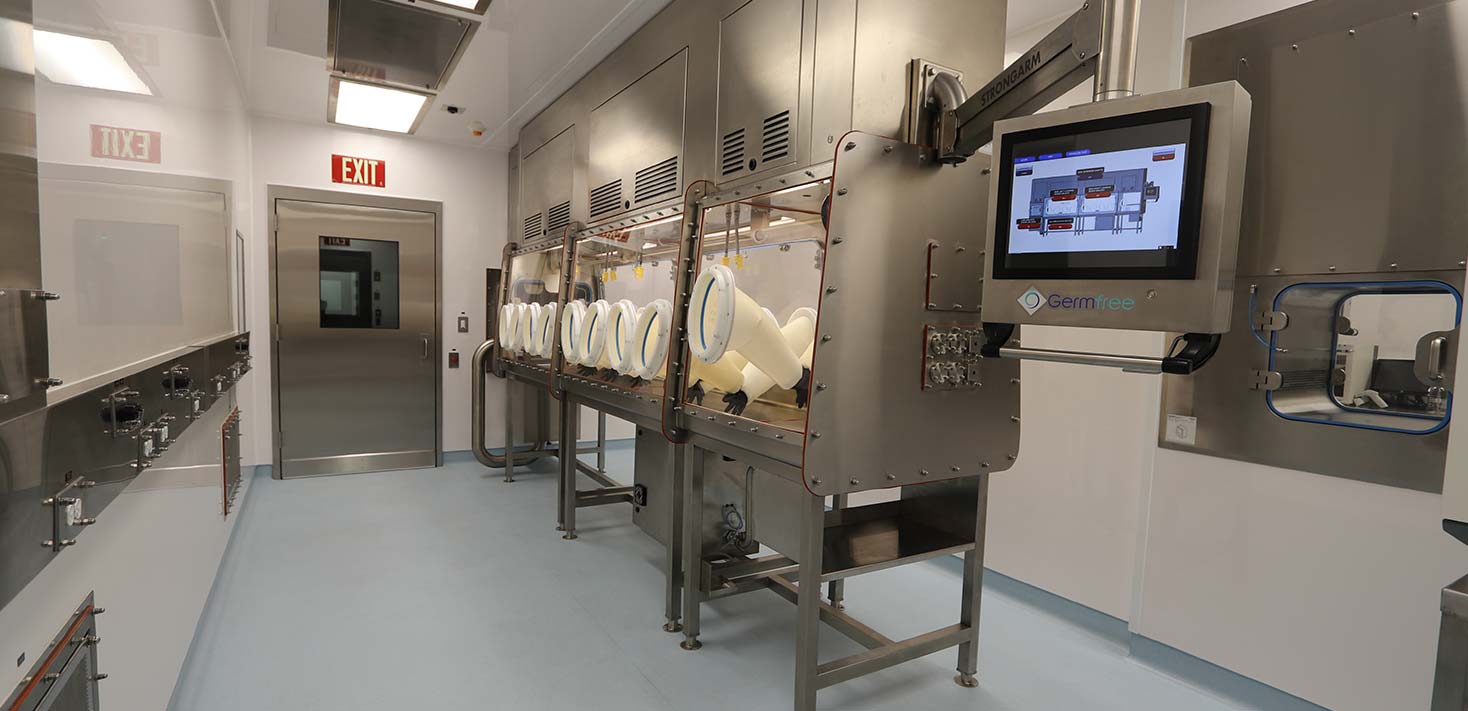
Integrated Material Pass Through
Custom Equipment Designed by Germfree
Durable seamless primary wall
Cleanable, coved flooring
Low Wall Returns
Video
https://www.youtube.com/watch?v=apNJjrSyd24
Suitability box
Suitability
Designed to meet the needs of multiple applications, the Class II Type A2 Biological Safety Cabinet (BSC) is ideal for a wide range of industries and facilities.
Facility highlights
Germfree cGMP modular cleanrooms are a platform solution that unlock standalone manufacturing capacity for a variety of applications. Serving processes from cell therapy to sterile fill-finish manufacturing cGMP modular facilities offer unmatched finishes, layout flexibility, controls, timeline assurance, and cost benefits for the biopharmaceutical industry. This is why Germfree has been chosen by 12 of the top 20 biopharmaceutical companies as their modular cleanroom providers.
Modular cleanrooms highlights

Biopharma

International building codes, IBC, NFPA, ISO. BSL-2 BMBL, FDA, EMA, cGMP compliant.
Smart hood hero
A single solution for consistent, compliant IV prep
Standardize your IV workflow process with Smarthood™
Smart hood carousel next to text


Designed to keep every step inside the sterile field
Smarthood™ brings your full IV prep workflow into one integrated, sterile workspace. No more moving between devices or breaking sterile technique. Everything from scanning components to labeling final products happens right in the hood.
- Integrates with existing IV workflow software
- Precise gravimetric measurements
- Built-in communication through MS Teams
- All components within sterile field
- No-touch scanning and photos
- Available as Horizontal LAFW or BSCA (4 & 6 ft.)
Smart hood carousel next to text
Two configurations. One seamless workflow.
Smarthood™ is engineered to support hazardous and non-hazardous IV workflows. Choose between Horizontal Laminar Flow Hood or BSC-A models.

Wave-to-open trash chute
Field of view cameras
PC + photo light-plate
Jabra speakers featured in both PECs
Label printer + scanner
PC + photo light-plate
Label printer + scanner

