

 Biocontainment
 Biopharma
 Healthcare



 Brochures
 User Manuals



Smarter Containment: How AI is Reshaping Aseptic Environments
Industry:
Biopharma, 503B Pharmacies
Type:
Article
As Featured in the August 2025 Edition of "Life Sciences Insights"
Cleanroom isolators are built to protect product integrity and ensure aseptic control—but even the most advanced systems today still rely on fixed routines and operator input. What happens inside the isolator often follows a rigid path: programmed cycles, manual interventions, and pre-set timelines. But what if isolators could adapt in real time, making decisions based on what’s actually happening inside the chamber?

Artificial intelligence opens the door to more dynamic, responsive isolator environments. Rather than operating on static logic, isolators could learn from patterns, respond to sensor data, and optimize internal workflows— minimizing contamination risks and reducing downtime.
Imagine an isolator where internal movements—whether robotic, operator-assisted, or semi-automated—are optimized in real time by AI. This goes beyond basic programming. Intelligent path planning could adapt to shifting conditions inside the chamber: avoiding areas recently exposed to higher particulate levels, dynamically adjusting movements to prevent cross-contamination, and predicting the most efficient task flow based on the current process stage.
AI could also support closed-loop decontamination strategies by analyzing activity patterns inside the isolator and initiating targeted cleaning cycles only when—and where—they’re needed. This approach could reduce downtime, preserve resources, and extend the operational readiness of the system.
At Germfree, we design and manufacture custom isolators for pharmaceutical, healthcare, and biocontainment applications. While our isolators do not currently include AI systems, we’ve worked alongside organizations that are taking meaningful steps toward this future—integrating robotics and automation into aseptic environments in ways that align with AI’s potential.
The integration of AI into isolator design is still emerging, but the groundwork is here. With intelligent motion planning, behavior modeling, and predictive system control, isolators may soon become more than static containment systems—they could become collaborative tools that anticipate and respond to the needs of modern aseptic workflows.
Read the complete August 2025 issue of Life Sciences Insights here.
You might also be interested in

Inside Germfree’s Mobile BSL-2 Laboratory

Why Mobile and Modular Cleanrooms are Changing the Game in Bio-Manufacturing
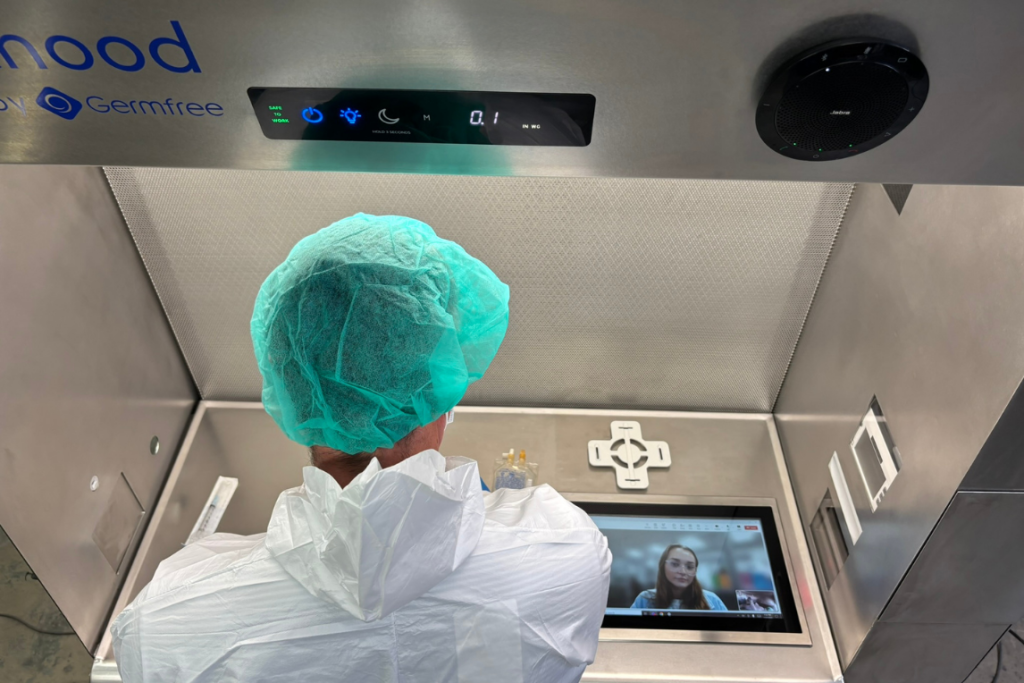
Smarthood™: Setting a New Standard in IV Compounding
Contact us: Let's unlock your scientific potential together
Complete our contact form and a member of our commercial team will contact you within 24 hours.

Sales: + 1 (386) 265-4300


