

 Biocontainment
 Biopharma
 Healthcare
 Brochures
 User Manuals


Rethinking Biomanufacturing: How Modular Infrastructure Is Accelerating the Future of Advanced Therapies
Industry:
Biopharma
Type:
Interview
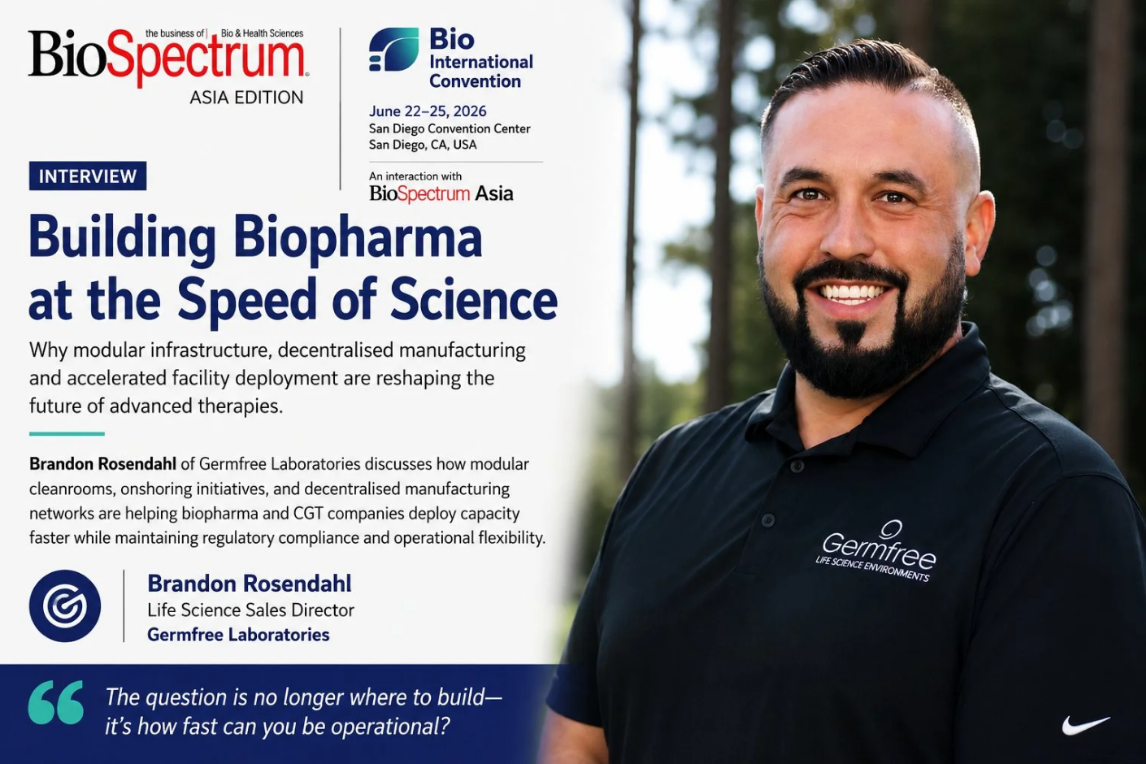
Brandon Rosendahl, Germfree's Senior Sales Engineer, sits down with BioSpectrum Asia to discuss modular cleanrooms, decentralized manufacturing, onshoring strategies, and the infrastructure innovations reshaping biopharma and cell and gene therapy production.
As biologics and cell and gene therapies continue to advance, manufacturing infrastructure is emerging as a critical determinant of speed, scalability, and market access. Traditional facility construction timelines often struggle to keep pace with scientific innovation, prompting organizations to explore more agile alternatives.
During BIO International Convention 2026 in San Diego, BioSpectrum Asia spoke with Brandon Rosendahl of Germfree Laboratories about the growing role of modular and mobile manufacturing environments, the rise of decentralised production models, and how companies can accelerate facility deployment while maintaining stringent regulatory compliance. He explains why infrastructure flexibility may become one of the industry’s most important competitive advantages in the decade ahead.

As companies seek faster deployment of manufacturing capacity, how is modular infrastructure changing facility planning?
Modular infrastructure is fundamentally changing the sequence of facility planning, not just the construction method. In a traditional build, process design, architecture and engineering, construction, and commissioning happen in series, which means equipment cannot be validated until the building exists around it. With a modular approach, those workstreams decouple. While a site team handles civil work, permitting, and utility tie-ins, fabrication, fit-out, and factory testing of the cleanroom modules can happen simultaneously in a controlled manufacturing environment. That parallel execution is what compresses a typical 18-to-36-month conventional build into a year or less.
Because a modular cGMP suite can be specified, quoted, and fabricated against a known, fixed-price scope, leadership can commit to capacity decisions with real cost and schedule certainty rather than carrying the open-ended risk of a ground-up build. We’re seeing facility planning shift from “where do we build and how long will it take” to “what configuration do we need, how quickly can it be operational, and what happens if our pipeline changes.” It’s a more dynamic, less permanent way of thinking about capacity – one that lets organizations move at the same speed as the science.
We’re seeing facility planning shift from “where do we build and how long will it take” to “what configuration do we need, how quickly can it be operational, and what happens if our pipeline changes.”
What advantages do mobile and modular cleanrooms offer compared with traditional brick-and-mortar facilities?
The headline advantage is speed, but the deeper advantage is risk reduction across the entire lifecycle.
On timeline, a factory-built mobile or modular cleanroom is typically operational within 6 to 12 months from order versus 2 to 4 years for a conventional build. Fabrication happens off-site in controlled conditions, in parallel with site readiness, and quality is verified through factory acceptance testing before the unit ships.
Beyond timeline, there are four advantages that consistently drive the decision:
- First, budget certainty. Modular projects are generally quoted and contracted at a fixed price, which removes the change-order risk that tends to accumulate in traditional construction.
- Second is quality consistency. Because modular infrastructure is built in a repeatable manufacturing process rather than by a different trade crew on every job site, materials and finish quality are more predictable, which translates directly into easier validation.
- Third is flexibility. Mobile and modular solutions are assets, not just buildings. An ISO 7 cleanroom or a mobile BSL-2/BSL-3 lab can be relocated, resold, or reconfigured as a company’s pipeline or geographic footprint evolves. A fixed structure cannot.
- And fourth, for organizations with constrained sites, a mobile or modular unit can typically be installed and connected to utilities with far less disruption to ongoing operations than a traditional addition or renovation.
How are onshoring initiatives influencing infrastructure investments across biopharma and CGT?
Onshoring is one of the strongest tailwinds in both biopharma and cell and gene therapy right now. The COVID-19 pandemic exposed how fragile a globally distributed supply chain for critical medicines really is, and that lesson hasn’t faded. Governments across North America, Europe, and increasingly Asia-Pacific are backing that concern with real policy: incentive programs, grants, and procurement preferences aimed at building domestic manufacturing capacity for vaccines, biologics, and advanced therapies.
The challenge is that “build domestic capacity” and “do it quickly” are often in direct tension when a conventional facility build takes several years. Modular and mobile infrastructure has stepped into that gap. Organizations that need to establish in-country cGMP manufacturing on a policy-driven or contractually driven timeline now have a realistic path to do it in months rather than years, without committing the full capital cost of a permanent facility to a program that may still evolve. That same dynamic is playing out internationally. Foreign governments and institutions increasingly want sovereign manufacturing capability for biologics or cell therapy, and the economics and timelines of conventional construction make that a difficult case to justify.
Organizations that need to establish in-country cGMP manufacturing on a policy-driven or contractually driven timeline now have a realistic path to do it in months rather than years, without committing the full capital cost of a permanent facility to a program that may still evolve.
What role will decentralized manufacturing play in the future of advanced therapies?
For cell and gene therapy specifically, decentralized manufacturing isn’t just a future trend, it’s a clinical necessity. Autologous CAR-T and other patient-specific therapies are constrained by vein-to-vein time: a patient’s cells have to be collected, manufactured into product, and returned to that same patient, often while they’re seriously ill. Every additional step between a centralized manufacturing site and the patient adds time, cost, chain-of-custody risk, and ultimately clinical risk. Locating GMP-compliant manufacturing closer to the point of care meaningfully shortens that loop.
The barrier has always been that building a fully compliant cleanroom suite inside or adjacent to every hospital or treatment center that needs one is impractical under a conventional construction model. Modular infrastructure changes that equation by enabling a network of standardized, pre-validated manufacturing nodes across multiple clinical sites rather than forcing all volume through one central facility. Because each node is built to the same validated design, you also get a more consistent answer to the regulatory and quality question – comparable performance and compliance at every site in the network. This model will likely expand from CAR-T into other autologous and point-of-care therapies, and into emerging markets where the demand exists.
How can organizations maintain regulatory compliance while accelerating facility deployment timelines?
Speed and compliance aren’t in conflict if the approach is engineered for both from the start. The mistake is treating compliance as something to address at the end of a build rather than something designed in from the beginning.
The approach that holds up best in practice starts with designing to recognized global standards from the first layout drawing, so nothing requires retrofitting later to meet a standard it wasn’t originally designed against. Factory acceptance testing and qualification documentation should be generated in parallel with fabrication, not after delivery. That way an organization arrives on-site with most of its validation package substantially complete and only operational and performance qualification remaining once utilities are connected. When a standardized design is replicated across multiple sites, those qualification protocols become reusable too, which compounds the time and cost savings at scale.
The other factor that separates organizations that move quickly from those that don’t is when they bring regulatory and quality expertise into the facility design conversation. Teams that engage their QA function early, mapping facility design to their specific submission or audit requirements before anything is built, rarely face the documentation gaps that surface when compliance is treated as an afterthought. The vendors and partners worth working with treat that conversation as part of the scope, not a separate engagement.
You might also be interested in
Rethinking Biomanufacturing: How Modular Infrastructure Is Accelerating the Future of Advanced Therapies
When Every Minute Matters: Reliable Containment for Ebola Response
A Guide to Airflow Design Models in Cleanrooms
Contact us: Let's unlock your scientific potential together
Complete our contact form and a member of our commercial team will contact you within 24 hours.

Sales: + 1 (386) 265-4300


